How MedTech funding signals drive opportunity for MedTech Service Providers
December 29, 2025 | Kevin Saem, Ph.D. |
Industry Articles
Funding is a crucial element in the growth and success of any MedTech business. With the rapid advancements in medical technology, securing the right type of funding can be the deciding factor that propels a MedTech startup from concept to reality. MedTech startups often require substantial and continued funding to support research and development, regulatory approvals, and market launch efforts when developing advanced devices, equipment, and systems that improve healthcare services.
However, navigating the different types of funding available can be challenging. In this article, we will break down the various types of funding in the MedTech industry and how companies leverage the funding to drive business growth.
Types of funding in MedTech
Bootstrapping
In the early days before external investors get involved, many founders begin by bootstrapping—using personal savings, day-job income, or early consulting revenue to fund ideation and prototyping. This type of funding is typically leveraged during conceptualization, when a founder is determining whether or not the idea can materialize into a business. The founder maintains total control of the business direction with no dilution of company value, but also assumes all risk and financial responsibility.
Angel Investors
Angel investors are individuals who provide capital to startups in exchange for equity ownership or convertible debt. These investors are typically high-net-worth individuals looking to invest in promising startups. For MedTech startups, angel investors can offer not only financial support but also valuable industry insights and connections. ‘Angels’ frequently bridge the gap between bootstrapping and VC readiness.
Venture Capital
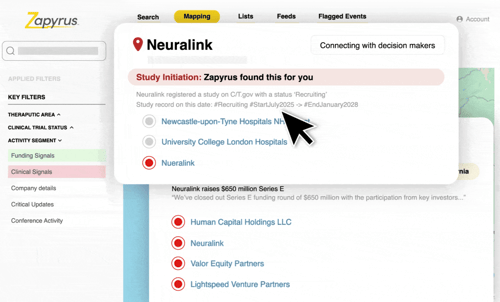
Venture capital (VC) firms invest in startups with high growth potential in exchange for equity. Unlike angel investors, VC firms manage pooled funds from several investors and typically invest larger amounts. Venture capital is suitable for MedTech startups that have a viable product and need significant capital to scale operations. However, securing VC funding can be competitive and often involves giving up a portion of control over the company. Zapyrus tracks funding activity across the MedTech industry and provides financing disclosure alerts when a company announces that it raised money through debt or equity.
Government Grants
Government grants are non-repayable funds provided by government bodies to support innovation and development in specific sectors. In the MedTech industry, these grants can be crucial for funding research and development projects, building scientific credibility and supporting high-risk innovation. However, they often come with strict criteria and reporting requirements that require extensive documentation, approval is slow and the MedTech industry is highly competitive. Zapyrus tracks MedTech grant activity and provides alerts when a company has received a grant from a government agency or non-profit charity.
Crowdfunding
Crowdfunding involves raising small amounts of money from a large number of people, typically via online platforms. Crowdfunding is less common in MedTech than traditional sources like venture capital (VC) and government grants. It is primarily used as an alternative or complementary source in MedTech, often for consumer-focused devices (like wearables or health apps) that resonate with the general public; it isn’t well-suited for clinical-grade, highly-regulated devices. It is generally most effective after the early R&D phase, for validation or prototyping, when tangible rewards can be offered or a compelling story can be told.
Strategic Partnerships
Strategic partnerships involve collaboration with established companies that provide funding, resources, or expertise in exchange for equity or other strategic benefits. For MedTech businesses, strategic partnerships can accelerate product development and market entry by leveraging the partner’s existing infrastructure, relationships and customer base. Large MedTech and pharma companies frequently invest in or partner with emerging startups as part of their innovation pipelines. This key element of MedTech business development is tracked in Zapyrus, from licensing deals and M&A announcements to collaboration agreements and partnership terminations.
Key Challenges in MedTech and where MedTech Service Providers can help expedite the process
1. Regulatory Hurdles
MedTech companies face some of the strictest regulatory pathways in any industry, and navigating the regulatory landscape can be costly and resource-intensive. When MedTech companies raise capital, the regulatory stage they’re in (or trying to reach) is one of the clearest indicators that they require outside expertise from MedTech service providers.
Opportunities for MedTech Service Providers to provide support
- Regulatory hurdle: Preparing an FDA 510(k) submission
Scenario: A startup developing a diagnostic device begins raising a Seed or Series A round because they need assistance with predicate comparison, substantial equivalence documentation, human factors validation, or quality management system readiness.
Actionable insights: At this stage, companies likely need regulatory consulting, clinical evidence partners, usability testing services, and documentation support. - Regulatory hurdle: Navigating FDA Breakthrough Device Designation (BDD)
Scenario: A company with a novel AI-enabled cardiac monitoring tool raises funding because they need help preparing a BDD application, developing early evidence packages, and structuring interactions with the FDA.
Actionable insights: Companies at this stage may need support from regulatory strategy firms, clinical data partners, or AI/ML compliance specialists. - Regulatory hurdle: Transitioning from R&D to ISO 13485 implementation
Scenario: A robotics device startup is raising funds to build and launch a compliant QMS (Quality Management System) that includes risk management, CAPA systems, design controls, supplier qualification.
Actionable insights: There is opportunity for service providers offering QMS build-out strategy, auditing services, gap analysis, and documentation digitization to support ISO 13485 certification and QSMR compliance.
2. Market Validation
Early-stage MedTech companies must prove clinical relevance, economic value, and user adoption — demonstrating demand and effectiveness before moving into commercial product development. When funding is secured for validation, it indicates the companies need external expertise to accelerate proof points and market readiness.
Opportunities for MedTech Service Providers to provide support
- Market validation need: Conducting early clinical feasibility studies
Scenario: A wearable respiratory monitoring company is raising Pre-Seed or Seed funding to secure clinical partners, collect pilot data, or run IRB-approved studies.
Actionable insights: MedTech companies at this stage need CRO partnerships, clinical research support, study design, and site recruitment. - Market validation need: Building real-world evidence (RWE) or health economics (HEOR) packages
Scenario: A digital health surgical planning platform is raising funds to build out cost-savings models or collect real-world usage data to support payer discussions.
Actionable insights: Companies at this stage may require HEOR consultants, data analytics firms, and payer strategy specialists to support these elements of development. - Market validation need: Securing KOL (key opinion leader) validation or advisory input
Scenario: A company developing a novel MedTech device raises capital to expand its advisory board, conduct surgeon usability testing, and gather real-world workflow insights.
Actionable insights: Opportunity for firms offering KOL recruiting, advisory board management, clinician engagement strategies, voice-of-customer research and CROs with advisory network capabilities. - Market validation need: Running structured market segmentation and demand modeling
Scenario: A biomaterials startup raises funding because they need professional market research to size clinical use cases, identify early adopters, and validate purchasing pathways.
Actionable insights: At this stage, companies likely need support from market research firms, commercialization and GTM strategists, clinical UX firms, and provider adoption consultants.
3. High Capital Needs
The MedTech development process is expensive — particularly when hardware, biological components, and clinical trials are involved. When companies raise larger rounds (Series A, B, or beyond), their capital needs often correlate directly with operational gaps that can be supported by MedTech service providers.
Opportunities for MedTech Service Providers to provide support
- Capital need: Scaling manufacturing or preparing for design transfer
Scenario: A surgical robotics company is engaged in a Series B fundraise to establish pilot manufacturing lines and complete DfM (Design for Manufacturing) and DfR (Design for Reliability) processes.
Actionable insights: Manufacturing design firms, supply-chain consultants, and contract manufacturing partners become highly relevant and critical during this stage. - Capital need: Expanding software engineering for SaMD or AI/ML models
Scenario: An AI diagnostic company is raising a Series C round to expand engineering capacity, refine models, and enhance cybersecurity compliance for FDA requirements.
Actionable insights: At this stage, companies can leverage AI/ML engineering firms, cybersecurity partners, SaMD development agencies, and data infrastructure support. - Capital need: Funding multi-center pivotal trials
Scenario: A Class III medical device company is preparing for pivotal trials to support global expansion (which can cost $20M–$100M+), looking to raise Series D funding.
Actionable insights: Companies moving into this phase will need CROs, clinical monitoring teams, data management platforms, statistical analysis partners, and trial operations support. - Capital need: Investing in go-to-market infrastructure
Scenario: A medical device company moving from regulatory clearance to commercialization raises capital to hire sales reps, set up distribution, and run payer-access programs.
Actionable insights: Opportunity for commercialization agencies, sales outsourcing firms, marketing strategy partners, and reimbursement consultants to support business growth and successful market penetration.
For MedTech service providers, understanding the types of funding available—and how companies typically allocate those funds—is essential for identifying when and where emerging MedTech innovators need support. Each funding stage signals different priorities, from early market validation to clinical studies, regulatory submissions, and commercialization. By aligning targeted outreach and offerings to these funding inflection points, service providers can position themselves as strategic partners at the exact moments MedTech companies are resourced and ready to act.
Zapyrus is the only tool built for MedTech service providers that provides real-time, actionable MedTech market insights to convert critical buying signals into revenue across your entire commercial team. This insight-driven approach not only improves targeting and timing, but also strengthens long-term relationships with high-growth MedTech companies that rely on the right expertise to accelerate their path to market.