August 14, 2026 | Dr Sadru Walji |
MedTech Industry Report
Earlier this month, a report by a global financial services firm highlighted a concerning trend for medical device executives: average decision times for original Premarket Approvals (PMAs) at the Food and Drug Administration (FDA) had reportedly spiked from 407 days in 2025 to a staggering 599 days in 2026 so far.
The state of the industry is already turbulent, driven by risk-averse investors, macroeconomic volatility, and ongoing supply chain recalibrations. For CROs and CDMOs, an added 200-day regulatory delay sounds calamitous. Longer review cycles mean your MedTech clients burn capital faster, commercialization roadmaps are delayed, and your own project kickoffs and revenue realization timelines get stretched.
However, surface-level metrics in public datasets rarely tell the whole truth. While the initial analyst reports acknowledged that a handful of statistical outliers were influencing the mean, they stopped short of investigating what those outliers actually were, and, more importantly, why they appeared in the dataset in the first place.
Those outliers are where the real story lies. Far from a sluggish or backlogged agency, a deeper look at the underlying metrics demonstrates that FDA PMA approval throughput is improving, median review times remain fast, and decision timelines are stable.
1. PMA Decision Lag vs. Throughput: What the Data Really Says
To evaluate the headline claim objectively, we queried the FDA PMA decision database directly. We were able to replicate their analysis by pulling all original PMA decisions granted between January 2022 and mid-2026.
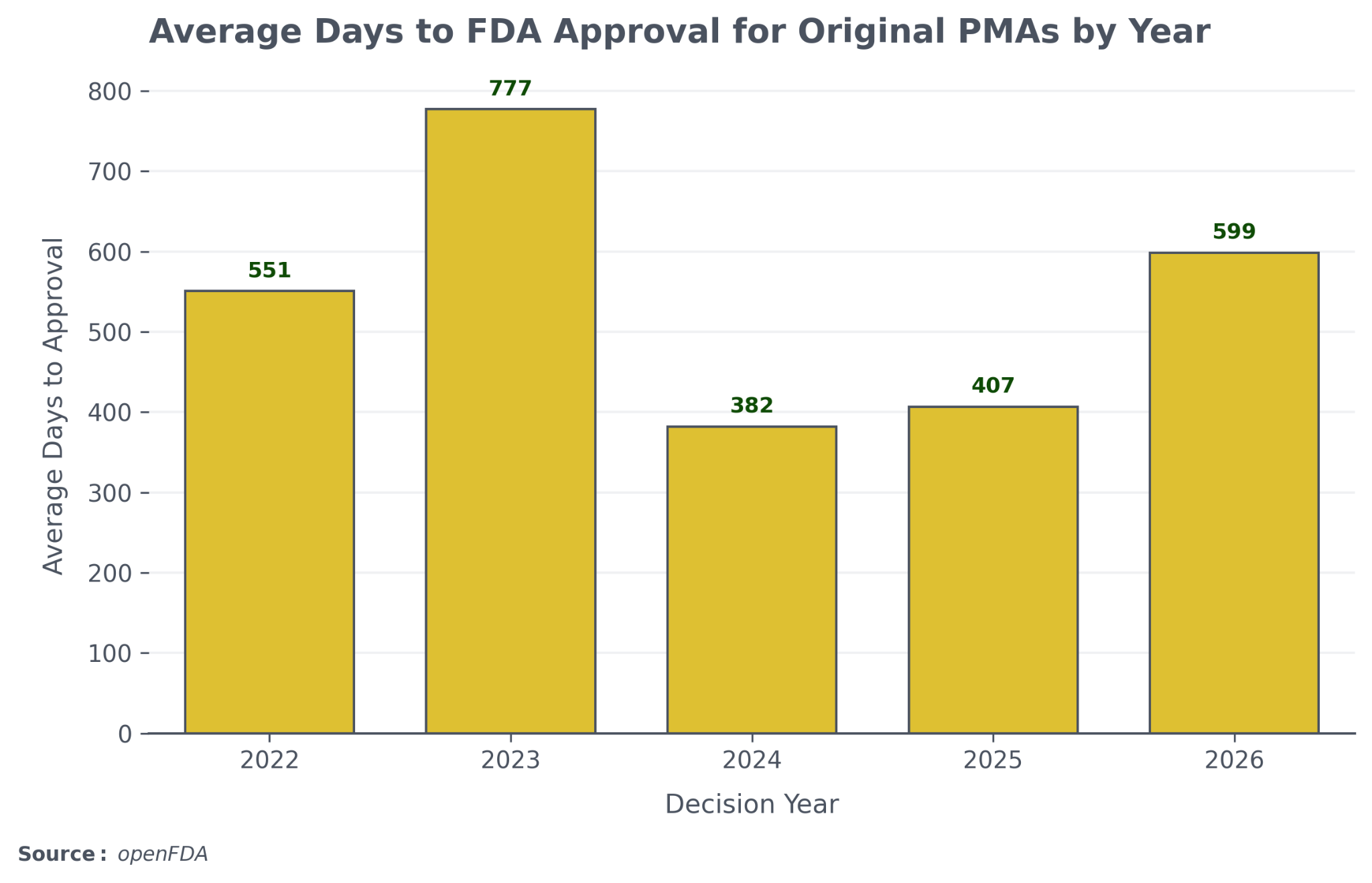 We can see the average for 2026 shows an upward spike to 599 days, representing the second-highest average review times in five years behind 2023’s peak of 777 days; exactly what the report concluded.
However, relying on approval times as a measure of FDA efficiency ignores an important metric: the pace at which the FDA is processing submissions. When the FDA clears out long-standing, multi-year files from its backlog, those decisions artificially inflate the average approval time for that calendar year, even if the FDA is reviewing new submissions at a faster pace.
To understand the true picture of the FDA’s processing capacity, we must evaluate decision throughput alongside timelines.
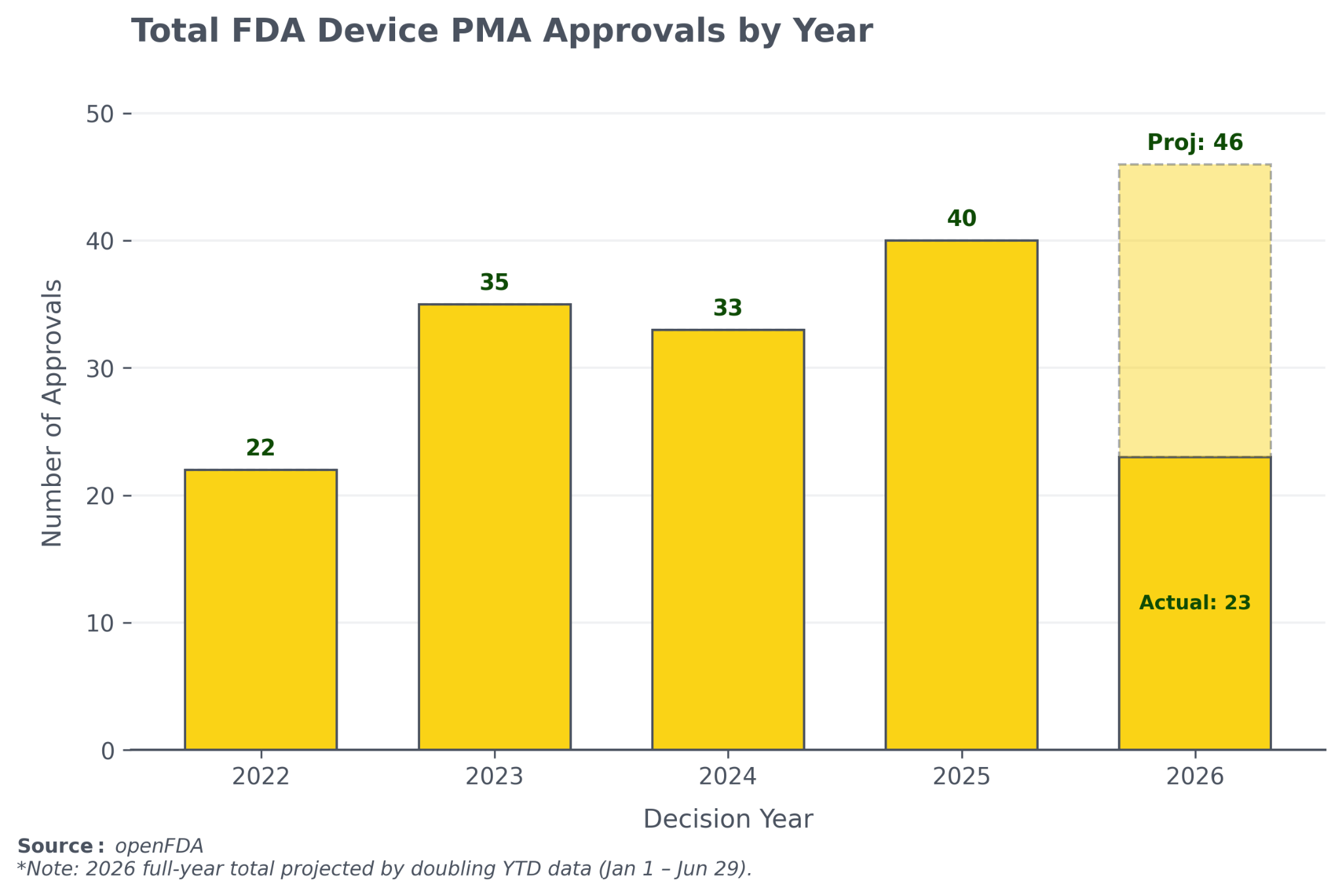 When total output is the focus, the narrative flips entirely. With 23 original PMAs approved in the first half of 2026 alone, end-of-year decision volume is on track to hit 46 total approvals. This represents a 5-year high in agency throughput, and a notable increase over the recent approval rates of 40 in 2025, 33 in 2024, and just 22 in 2022.
2. The Mean vs. Median Divide
Why is there such a drastic disconnect between the purported review time (599 days) and high agency output? The answer lies in basic statistical distribution. Averages (arithmetic means) are notoriously sensitive to extreme values.
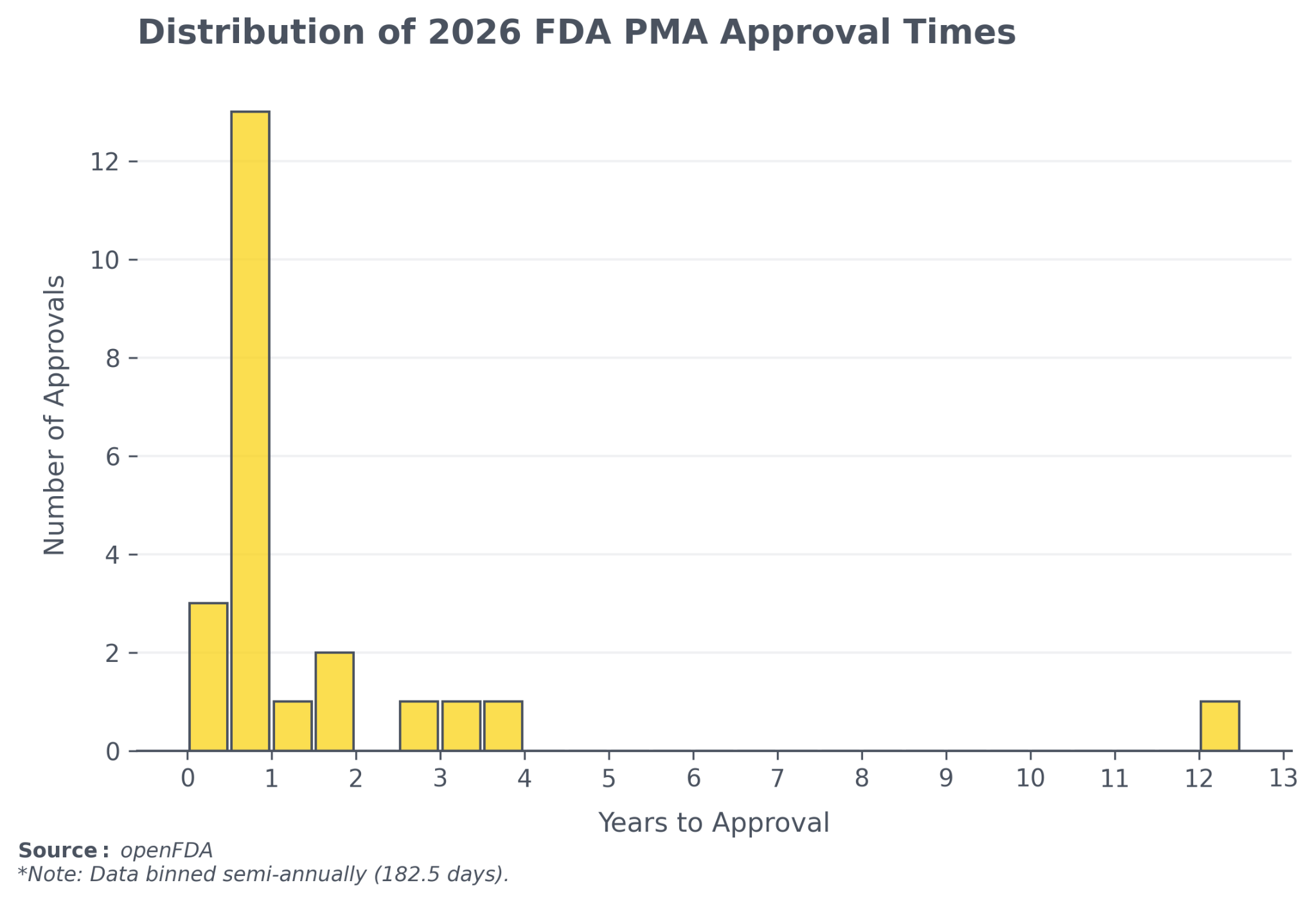 A distribution histogram of the 2026 approval times makes the skew glaringly obvious. Over 50% of all original PMAs approved in 2026 reached a decision in 315 days or less. The 599-day average is pushed upward almost single-handedly by a lone, extreme data point sitting out past the 4,000-day mark on the far right of the axis.
3. A Quick Look into the Outliers
Removing legacy submissions longer than 5 years (1,825 days) reveals a remarkable operating consistency.
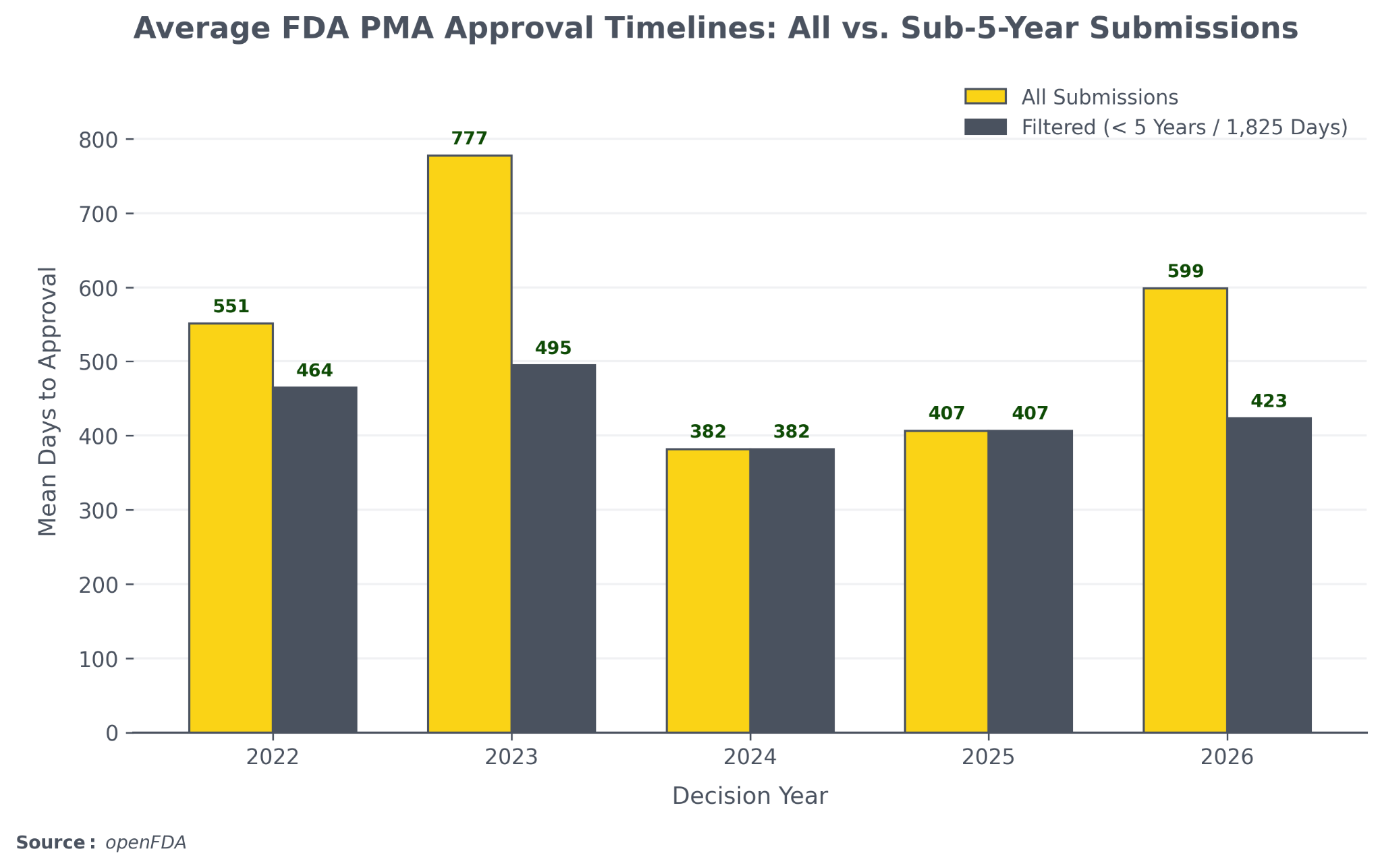
Filtering out these legacy files drops the 2026 average from 599 days down to 423 days. This places 2026 performance inline with historical baselines: 407 days in 2025, 382 days in 2024, and 464 days in 2022.
Anatomy of Multi-Year Approvals
Looking at the outliers, they weren't caused by FDA sluggishness. They were driven by three structural hurdles:
- Combination Products & Cross-Center Reviews: Devices incorporating biological markers or active drugs require joint reviews across FDA centers, inherently extending timelines.
- Corporate Restructuring: Financial distress, bankruptcies, or acquisitions lead to administrative pauses while new sponsors assume regulatory liability.
- Major Protocol Amendments: Extended cycles reflecting iterative submission cycles, like responding to FDA deficiency letters or updating bench testing, rather than continuous FDA processing.
4. The Phantom 12-Year Delay: Why Data Quality Matters
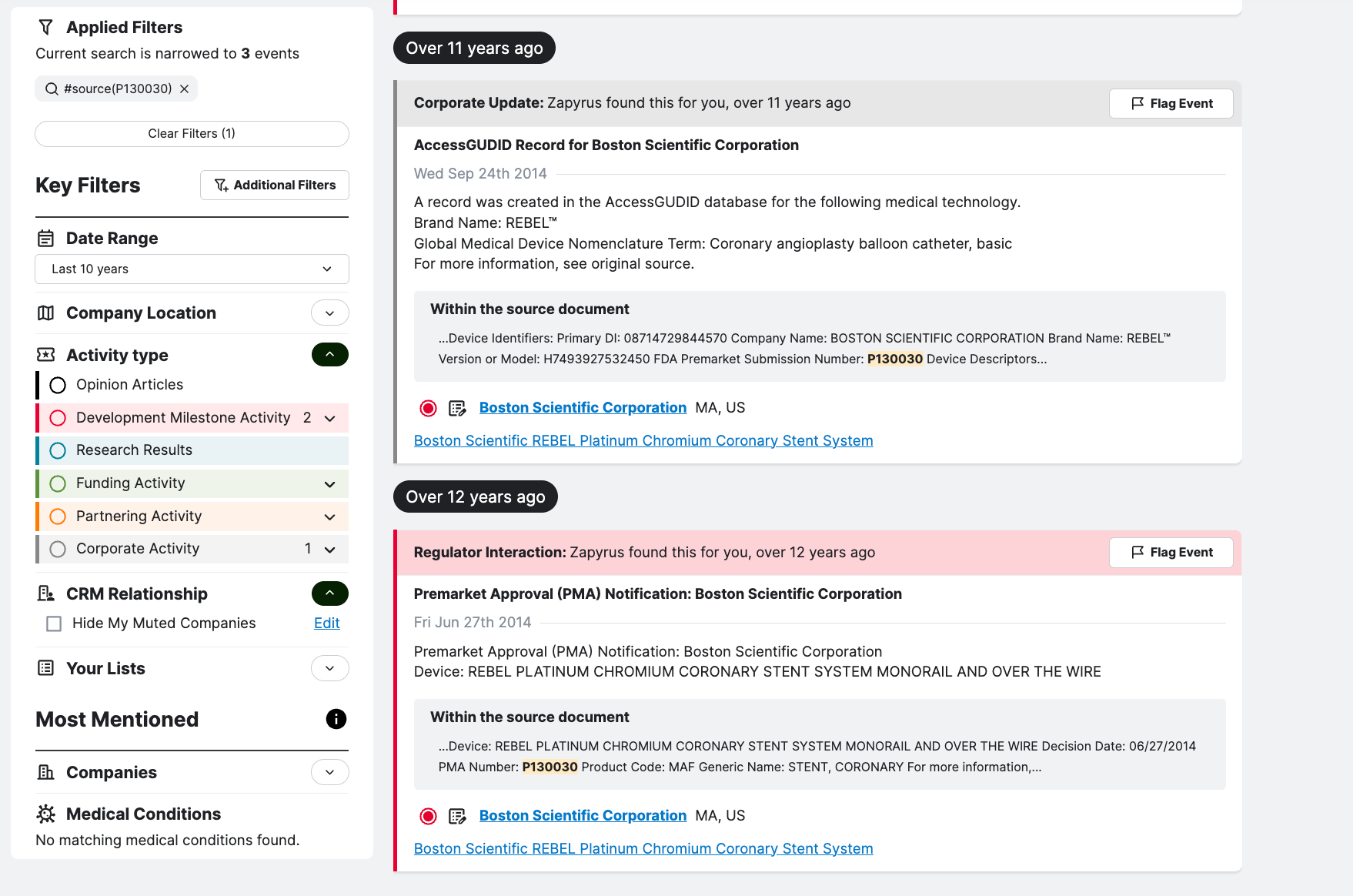
Looking at the table above, one extreme record stands out: Boston Scientific’s Rebel Coronary Stent System (P130030), recorded with a staggering 4,453 days-to-decision (over 12 years) on March 10, 2026.
|
Here is the twist: The Rebel Stent was actually approved in 2014. |
What happened? While we can’t be sure, administrative timestamp updates or database cleanup events within the FDA’s system can occur. Uncleaned web scrapers and automated analytics tools ingested this administrative refresh as a brand-new 2026 original PMA decision. While the reason for this error is purely speculative, the impact on industry perception is not.
This single phantom entry added over 4,000 artificial days to the 2026 calculation, single-handedly pulling the entire annual average upward by nearly 200 days.
While third-party reporting tools blindly published the error, triggering alarmist headlines about a slowing FDA, Zapyrus never fell for the anomaly. Our multi-stage verification architecture correctly matched the submission to its true 2014 approval history, preventing administrative artifacts from corrupting our market intelligence pipeline.
5. Strategic Implications for MedTech Vendors
For CROs, CDMOs, and other vendors in the MedTech space, this analysis provides three actionable takeaways:
- Advise Clients with Authority: Counter alarmist headlines using data verified from sources you trust, reassuring clients that 300 to 350 days remains the true benchmark.
- Audit Your Intelligence Sources: In an era of AI insights, truthful data is your ultimate competitive advantage. If your strategic planning, forecasting, or lead generation tools rely on raw, public feeds, you risk reacting to data glitches rather than genuine market trends.
- Forecast Revenue Accurately: By understanding what actually causes regulatory delays (combination products, clinical holds, restructuring), you can more accurately forecast your own revenue realization. You can build realistic pipeline contingencies, rather than blaming arbitrary agency stalling.
Conclusion: Accurate industry insights require reliable data
Market intelligence is only as valuable as the integrity of the underlying data. When MedTech teams base strategic choices on unverified public feeds, they risk building business plans around phantom trends and administrative artifacts.
The reality is clearer than the headlines suggest: FDA approval volumes are on track for multi-year highs, and median review times remain steady at under 11 months. Your clients' go-to-market timelines are safer than the headlines suggest.
|
Book a demo with Zapyrus today to see how trustworthy MedTech intelligence can bring clarity to your decision-making. |